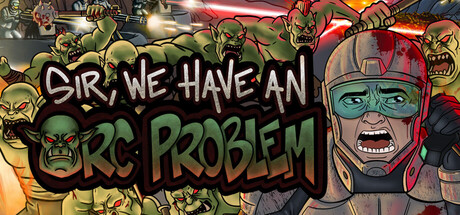
1. Introduction: Historical Context and Market Expectations
The indie tower defense ecosystem has recently undergone a major structural shift. Moving away from rigid, deterministic pathing models, modern indie developers are actively experimenting with emergent physics systems and massive scale mob generation to reinvigorate the genre. Entering this competitive landscape, Sir, We Have an Orc Problem captured widespread attention upon its initial public playtest. The game promised an intriguing hybrid gameplay premise: pairing screen-clearing waves of thousands of incoming orc swarms with a dynamic fluid physics simulation engine.
Evoking nostalgia for golden-era browser Flash strategy games while attempting to leverage contemporary particle rendering capabilities, the title generated notable community anticipation. Gamers were enticed by the prospect of controlling flowing liquid dynamics to wash away dense enemy formations in real-time. However, following its official commercial release, the full title exposes a stark divide between its brilliant underlying core physics hook and its fundamentally constrained content volume and progression architecture.
2. Gameplay Architecture: Core Loops and Innovation
The foundational core gameplay loop revolves around constructing specialized defensive towers alongside fluid-simulated channels, directing dynamic liquid currents to slow down, funnel, and obliterate massive swarms of green-skinned attackers. The implementation of real-time fluid mechanics represents a genuinely innovative departure from traditional static tower defense conventions. Rather than relying purely on maze building or DPS check barriers, players manipulate fluid vectors to control horde density and maximize area-of-effect damage, creating an invigorating mechanical feedback loop during initial encounters.
Regrettably, significant structural bottlenecks emerge when evaluating the game's meta-progression curve and tech tree balance. Once the initial novelty of liquid simulation begins to wear off around the mid-game milestone, players are confronted with a tedious resource farming requirement. Progressing through higher-tier technology upgrades forces players into replaying previously completed levels solely to accumulate upgrade currency—a classic mechanical artificially lengthening loop known as mid-game grinding.
Furthermore, once an optimized tower layout is established in late-game stages, active player agency precipitously drops. The active tactical positioning transforms into passive waiting sessions where the player merely observes the screen for minutes until the wave timer expires. This creates a severe UX bottleneck that directly contradicts the dynamic momentum showcased during early demo builds, diminishing the game's overall strategic depth.
3. Visual Architecture, Soundscapes, and Optimization Engineering
From an architectural standpoint, the visual design adopts a hyper-pragmatic, utility-first philosophy. By bypassing high-density texture maps and expensive post-processing lighting pipelines, the rendering engine devotes its computational power entirely to processing multi-agent pathfinding and thousands of fluid-particle interactions concurrently without frame rate stutter. While this utilitarian visual aesthetic may appear overly simplistic or retro to players accustomed to modern visual fidelity, the resulting technical optimization under extreme entity load is remarkably stable.
The user interface (UI) mirrors this philosophy, offering functional minimalism that ensures zero friction during tower selection and resource allocation. However, its lack of artistic refinement may turn off players looking for polished graphical presentation. In terms of audio design, the soundscape provides visceral feedback through crisp impact sounds during swarm annihilations, though the soundtrack itself lacks thematic variance, contributing to auditory fatigue during prolonged level farming sessions.
4. Global Community Sentiment & Final Verdict
A comprehensive synthesis of global user sentiment highlights a polarized player consensus. On the positive spectrum, community sentiment celebrates the refreshing fluid mechanics, the sheer satisfaction of wiping out thousands of enemies on screen simultaneously, and the clear 5-to-10-hour timeframe required to achieve a 100% completion status. Players appreciative of golden-era Flash strategy games praise its accessible, unpretentious fun.
Conversely, critical user feedback focuses heavily on the game's steep price-to-content ratio. Priced at approximately $10 USD, many players report completing the entirety of the tech tree and all achievements in under 5 to 6 hours without needing strategic guides. Critics express disappointment regarding the loss of momentum from the early beta releases, pointing out the lack of crucial replayability features such as an Endless Mode, map randomizer, or Steam Workshop level builder support. The transition from active strategy to passive tower waiting is widely cited as a key area needing mechanical rework.
In conclusion, Sir, We Have an Orc Problem stands as a mechanically inventive tower defense title that offers immediate, high-octane entertainment driven by fluid dynamics. However, its shallow endgame ecosystem and repetitive mid-game grind prevent it from reaching genre-defining heights. It remains a compelling proof-of-concept best recommended during promotional sales or following future feature updates.
👉 View on Steam


댓글 없음:
댓글 쓰기